Cannabis Topicals Explained: How Cannabis Creams, Balms & Oils Actully Work on Your Skin

Cannabis Creams, Balms & Oils: How Do They Actually Work?
As cannabis wellness becomes increasingly popular, many people are discovering a wide range of cannabis-infused products designed for different wellness goals.
Among the most popular options are cannabis topicals—including creams, balms, lotions, salves, and oils.
Yet one question continues to come up:
How do cannabis topicals actually work?
Many people assume that applying a cannabis cream to the skin allows cannabinoids to enter the bloodstream and affect the entire body.
The reality is quite different.
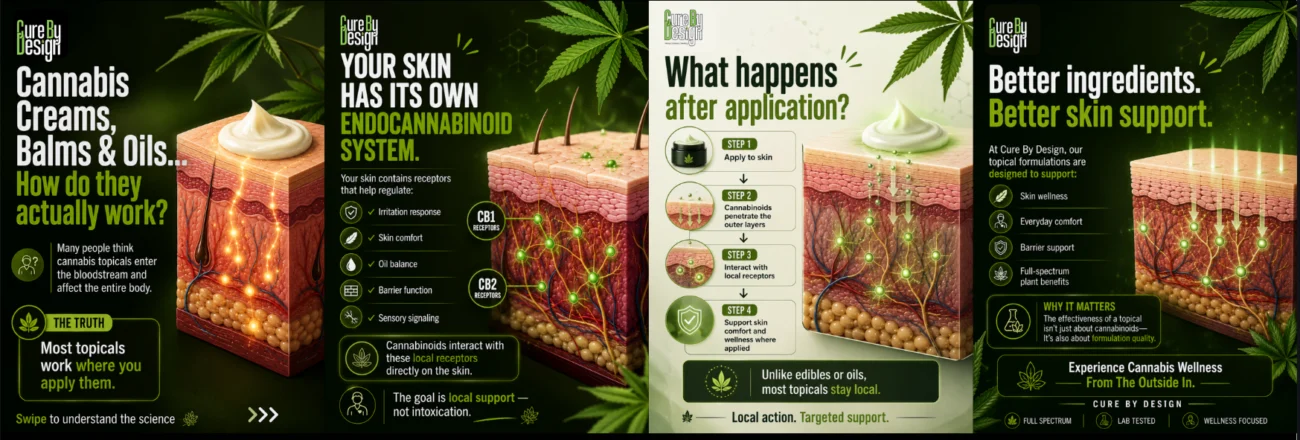
Most cannabis topicals are designed to work where they are applied, interacting with receptors located in the skin and surrounding tissues rather than producing whole-body effects.
Understanding the science behind cannabis topicals helps explain why they have become an important part of modern plant-based wellness routines.
In this guide, we’ll explore:
- What cannabis topicals are
- How cannabinoids interact with the skin
- The role of the Endocannabinoid System
- Why most topicals stay local
- The differences between creams, balms, and oils
- What makes a high-quality topical formulation
What Are Cannabis Topicals?
Cannabis topicals are products infused with cannabinoids that are applied directly to the skin.
Common forms include:
- Cannabis creams
- Cannabis balms
- Cannabis lotions
- Cannabis salves
- Cannabis oils
- Massage oils
- Body butters
Unlike ingestible products, topicals are intended for localized application.
Rather than traveling throughout the body, cannabinoids in topical formulations primarily interact with receptors located in the skin and nearby tissues.
This targeted approach makes cannabis topicals a unique category within cannabis wellness.
The Skin Is More Than a Protective Barrier
Most people think of skin as a simple protective covering.
In reality, the skin is one of the body’s most complex organs.
It contains:
- Sensory receptors
- Immune cells
- Nerve endings
- Hair follicles
- Oil glands
- Specialized signaling pathways
Scientists have also discovered that the skin contains components of the Endocannabinoid System (ECS).
This finding has transformed how researchers understand skin wellness and cannabinoid science.
What Is the Endocannabinoid System (ECS)?
The Endocannabinoid System is a biological communication network found throughout the human body.
Its primary role is helping maintain internal balance, also known as homeostasis.
The ECS influences many functions including:
- Mood
- Sleep
- Stress response
- Immune function
- Recovery
- Sensory signaling
- Skin balance
The system consists of:
Endocannabinoids
Naturally occurring compounds produced by the body.
Receptors
Specialized structures that receive cannabinoid signals.
Enzymes
Compounds that help create and break down endocannabinoids.
Researchers have identified ECS-related activity throughout the skin, which helps explain why topical cannabinoids are receiving growing scientific interest.
Your Skin Has Its Own Endocannabinoid System
One of the most fascinating discoveries in cannabinoid science is that the skin possesses its own network of cannabinoid receptors.
These receptors help regulate:
- Skin comfort
- Oil production
- Barrier function
- Irritation response
- Sensory signaling
Two receptor types commonly discussed are:
CB1 Receptors
CB1 receptors are associated primarily with nerve signaling and communication pathways.
In the skin, they may play a role in sensory processes and overall balance.
CB2 Receptors
CB2 receptors are more closely linked to immune-related activity and inflammatory responses.
These receptors are widely distributed throughout the body and are also found within skin tissues.
When cannabinoids are applied topically, they may interact with these local receptors.
This interaction is one reason why cannabis topicals are becoming increasingly popular in wellness-focused skincare and recovery routines.
What Happens When You Apply a Cannabis Topical?
Let’s break the process down step by step.
Step 1: Application
A cannabis cream, balm, or oil is applied directly to the target area.
This could include:
- Shoulders
- Knees
- Back
- Neck
- Elbows
- Skin areas requiring support
Step 2: Penetration of Outer Skin Layers
The formulation begins interacting with the outer layers of the skin.
Different ingredients influence how effectively cannabinoids reach local tissues.
This is one reason formulation quality matters.
Step 3: Interaction with Local Receptors
Cannabinoids may interact with ECS-related receptors located in the skin.
These interactions occur locally at the application site.
Step 4: Localized Wellness Support
Unlike ingestible products, most topicals remain concentrated in the area where they are applied.
The goal is targeted support rather than systemic effects.
Do Cannabis Topicals Enter the Bloodstream?
This is one of the biggest misconceptions surrounding cannabis topicals.
Most standard cannabis creams, balms, and lotions are designed to work locally.
They generally do not enter the bloodstream in significant amounts.
Instead, cannabinoids primarily interact with receptors located in the skin and nearby tissues.
This localized activity is one of the reasons topical products are popular among people seeking targeted wellness support.
It’s important to note that specialized formulations known as transdermal products are different.
Transdermal systems are specifically engineered to deliver compounds beyond the skin barrier and into circulation.
Standard cannabis topicals, however, are typically intended for localized application.
Cannabis Creams vs Balms vs Oils
Although these products share similarities, they each serve different purposes.
Cannabis Creams
Creams contain both oil and water.
Benefits include:
- Lightweight texture
- Easy absorption
- Everyday use
- Comfortable application
Creams are commonly chosen for larger areas of the body.
Cannabis Balms
Balms typically contain waxes and oils.
Benefits include:
- Rich texture
- Longer-lasting application
- Concentrated formulas
- Protective skin feel
Balms are often preferred for focused application.
Cannabis Oils
Cannabis oils are generally liquid formulations.
Benefits include:
- Massage-friendly
- Flexible application
- Easy spreading
- Skin conditioning support
Many users incorporate oils into self-care and recovery routines.
Why Formulation Quality Matters
Cannabinoids are only one part of an effective topical product.
The supporting ingredients play an equally important role.
High-quality formulations often include:
- Botanical extracts
- Carrier oils
- Plant-based ingredients
- Skin-conditioning compounds
- Stabilizing ingredients
A poorly formulated product may not deliver the same experience as a carefully designed formulation.
When evaluating cannabis topicals, it’s important to look beyond cannabinoid content alone.
What Makes a Premium Cannabis Topical?
Not all cannabis wellness products are created equally.
A premium topical should emphasize:
Quality Ingredients
Clean, thoughtfully selected ingredients support overall product quality.
Transparent Manufacturing
Reputable brands prioritize transparency throughout the production process.
Third-Party Testing
Independent testing helps verify product consistency and quality.
Full-Spectrum Formulations
Many wellness enthusiasts prefer formulations that preserve a broader range of naturally occurring plant compounds.
Consistent Standards
Reliable manufacturing practices help ensure a dependable user experience.
The Growing Interest in Cannabis Skin Wellness
Scientific interest in cannabinoids and skin wellness continues to expand.
Researchers are actively studying:
- ECS activity in the skin
- Cannabinoid receptor function
- Skin barrier support
- Localized cannabinoid interactions
- Plant-based wellness applications
As understanding of the ECS grows, cannabis topicals are increasingly viewed through a scientific lens rather than simply a wellness trend.
This shift is helping consumers make more informed decisions about the products they choose.
Why More People Are Choosing Cannabis Topicals
Modern wellness consumers are seeking products that align with a holistic approach to self-care.
Cannabis topicals appeal to many individuals because they offer:
- Targeted application
- Plant-based ingredients
- Localized support
- Simple integration into daily routines
- Non-intoxicating wellness options
For many people, topicals provide a practical way to explore cannabinoid wellness without altering daily activities.
Choosing the Right Cannabis Topical for Your Needs
When selecting a topical, consider:
Product Type
Cream, balm, oil, or lotion.
Ingredients
Look for premium, transparent formulations.
Application Area
Some products are better suited for larger areas, while others excel at targeted application.
Brand Reputation
Choose brands that prioritize quality, transparency, and testing.
Wellness Goals
Different formulations may support different preferences and routines.
Final Thoughts
Cannabis topicals represent one of the most fascinating intersections between nature and modern science.
Far from simply sitting on the skin, cannabinoids interact with a sophisticated network of receptors that help regulate balance, comfort, and skin wellness.
The key takeaway is simple:
Most cannabis creams, balms, and oils are designed to work where you apply them.
Rather than affecting the entire body, they interact with local receptors within the skin and surrounding tissues.
As research into the Endocannabinoid System continues to evolve, cannabis topicals are becoming an increasingly important part of plant-based wellness conversations.
The future of cannabis wellness isn’t just about what you take internally.
Sometimes, support begins exactly where you need it.